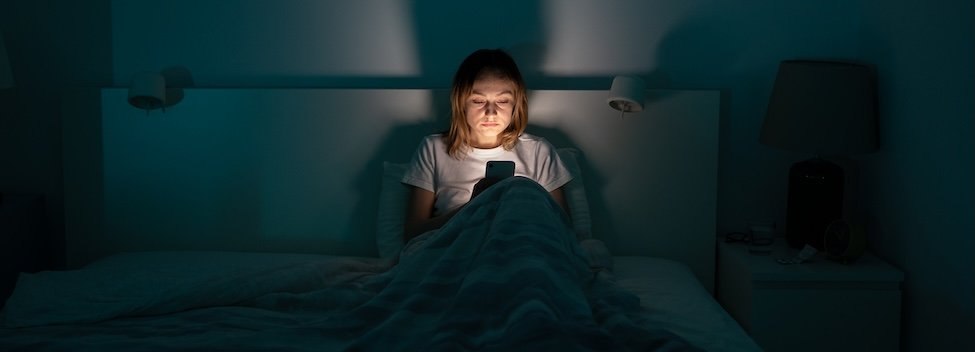

Recent YouGov surveys explore how much time Americans are spending looking at screens, how they feel about their phone usage, and the effect they believe it’s having on them. Data suggests the “kids” might not be alright: Adults under 30 are more likely than older Americans to spend more time looking at screens, to sleep with their phone in bed, to use their phone immediately upon waking, and to believe their phone is negatively affecting their sleep habits and attention span.
The majority (57%) of Americans say they are spending at least five hours a day looking at screens. 21% think they usually spend five to six hours looking at screens, 16% estimate it’s seven to eight hours, 13% think it’s nine to 12 hours, 4% think it’s 13 to 16 hours, and 3% say they spend more than 16 hours a day looking at a screen.
One-third (32%) of adults under 30 spend more than nine hours a day looking at a screen — compared to 24% of 30- to 44-year-olds, 16% of 45- to 64-year-olds, and 11% of Americans 65 and older.
More Americans say screen time has a very or somewhat positive impact on their lives than say it has a negative one (37% vs. 23%). Adults under 45 are about equally likely to say screen time has a positive effect on their lives as to say it has a negative one (33% vs. 29%). Americans 45 and older are much more likely to say screen time has a positive effect than a negative one (41% vs. 17%).
About half (53%) of Americans want to reduce the amount of time they spend looking at screens and one-third (34%) say they do not. Adults under 30 are more likely than older Americans to say they want to reduce the amount of time they spend looking at screens (69% vs. 48%).
36% of Americans say that within the last 12 months, they have intentionally tried to reduce the amount of time they spend looking at screens. Among adults under 30, 47% say they have tried to do this in the past year, compared to 32% of older Americans.
17% of Americans have used an app to track or limit their screen time. 37% of adults under 30 have used an app for this, as have 21% of 30- to 44-year-olds and 8% of people 45 and older.
Among people who have used a screen-time-limiting app, 52% say these apps have been very (12%) or somewhat (40%) effective at reducing their screen time. 39% say they have been not very (28%) or not at all (12%) effective.
Much of the screen time Americans are logging is likely spent on their phone — 97% of Americans say they own a smartphone.
Two-thirds (64%) of Americans say they look at their phone at least one or two times when they’re spending time with a friend. About half (54%) look at their phone this much when they’re eating a meal with others, and 28% of Americans say they look at their phone at least one or two times when they’re on a date.
Majorities of Americans say it’s unacceptable for someone to check their phone during a date (79%) or during a meeting at work (76%). About half (49%) say it’s unacceptable for someone to look at their phone while spending time with a friend.
40% of Americans say they check their phone more often than they’d like to, including 20% who do this much more often than they’d like to. 50% of Americans say they check their phone about as often as they’d like to. Only 4% are checking their phone less often than they’d like to.
For most Americans, their phone is pretty much always close at hand, even when they’re sleeping. 20% say when they go to sleep, they leave their phone on the bed next to them and 53% leave it directly next to the bed, such as on a nightstand or side table. Adults under 30 are more than twice as likely as older Americans to go to sleep with their phone on the bed next to them (38% vs. 16%).
For many Americans, their smartphone is the last thing they see at night and the first thing they see in the morning. 43% of Americans — including 61% of adults under 30 — say they always or often use their phone to browse the internet and use apps within 10 minutes of falling asleep at night. 44% of Americans — including 60% of adults under 30 — always or often use their phone to browse the internet or use apps within 10 minutes of waking up in the morning.
How long could Americans comfortably go without their smartphone? Thinking about leisurely/non-work use, 8% think they would make it an hour or less. 22% think they could comfortably go a few hours, 17% think they could make it a full day, and 13% think they could make it a few days. 15% think they could make it between a week and one month without their phone comfortably, 3% think they could make it between three months and one year, and 12% think they could go more than a year.
Americans 65 and older are more likely than younger adults to say they could go at least a week without their smartphone (40% vs. 28%).
Many Americans want to take a break from their phone to focus on other activities. 39% say they want to do this, and often do. About one-quarter (24%) say they’d like to do this, but rarely or never do. 31% don’t ever wish they could take a break from their phone to focus on other activities.
Adults under 30 are more likely than older Americans to say they wish they could take a break from their phone to focus on other activities, but rarely or never do this (35% vs. 21%).
Two-thirds (65%) of Americans say they would find it easy to take a break from their phone if they wanted to; 31% would find it difficult. Americans over 65 are more likely than younger adults to say this would be easy (86% vs. 59%)
83% of Americans have tried at least one method to help them take a break from their phone. 37% have turned off notifications, 33% have used the phone’s Do Not Disturb mode, and 27% have completely powered off the phone. 26% of Americans have put their phone in another room, 25% have deleted apps that were distracting, and 15% have set aside phone-free times of day.
46% of Americans strongly or somewhat agree with the statement, “I waste too much time using my smartphone,” while 30% disagree. 42% agree that not having their phone with them makes them anxious; 35% disagree. Smaller shares agree with the statements “smartphones have strengthened my relationships with other people” (35%) and “I think I could be more productive if I didn’t have my smartphone with me” (32%).
Americans are more likely to say their phone has a mostly negative effect rather than a mostly positive one on their attention span (34% vs. 16%), their sleep habits (32% vs. 13%), and their ability to focus (31% vs. 18%). On the other hand, they’re much more likely to say that their phone has a mostly positive effect rather than a negative one on their knowledge of current events (67% vs. 3%), their personal safety (48% vs. 4%), their relationships with others (43% vs. 10%), and their creativity (38% vs. 9%).
Adults under 30 are much more likely than older Americans to say their phone has a mostly negative impact on their sleep habits (51% vs. 27%), their attention span (45% vs. 31%), and their ability to focus (41% vs. 17%).
Related:
- One in two millennial smartphone users experience anxiety without their phones
- Americans are increasingly likely to say AI will negatively affect society
- Ever snooped through a partner's phone? You're not alone
- Many Americans can't go more than a few hours without their smartphones
See the results for the May 23 - 26, 2025 and July 15 - 17, 2025 YouGov surveys.
— Carl Bialik and Taylor Orth contributed to this article
Methodology: This article includes results from two online surveys conducted on May 23 - 25, 2025 and July 15 - 17, 2025 among 1,129 U.S. adult citizens and 1,148 U.S. adult citizens. Respondents were selected from YouGov’s opt-in panel to be representative of adult U.S. citizens. The samples were weighted according to gender, age, race, education, 2024 presidential vote, 2020 election turnout and presidential vote, baseline party identification, and current voter registration status. 2024 presidential vote, at time of weighting, was estimated to be 48% Harris and 50% Trump. Demographic weighting targets come from the 2019 American Community Survey. Baseline party identification is the respondent’s most recent answer given around November 8, 2024, and is weighted to the estimated distribution at that time (31% Democratic, 32% Republican). The margin of error for each sample is approximately 4 percentage points.
Image: Getty
What do you really think about President Trump, American politics in general, and everything else? Share your reality, join the YouGov panel, and get paid to share your thoughts. Sign up here.