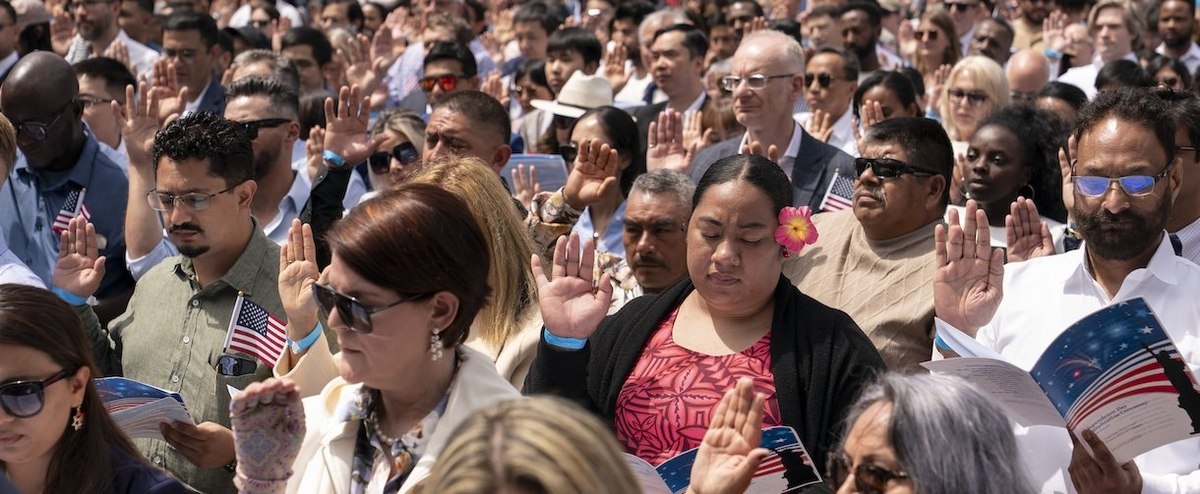

This month, Senator Bernie Moreno introduced a bill that, if passed, would end dual citizenship in the U.S. Currently, immigrants who become naturalized U.S. citizens may maintain their pre-existing citizenship as long as that country's laws allow it. Similarly, U.S. citizens who gain citizenship in another country generally keep their American citizenship. Under Moreno's proposal, dual citizens would be required to renounce either their foreign or U.S. citizenship. Those who do not voluntarily give up either citizenship would have their U.S. citizenship removed.
A new YouGov poll finds that most Americans don't support a ban on dual citizenship for immigrants who become U.S. citizens or for existing U.S. citizens who gain citizenship elsewhere. Small shares of Americans say that it's bad for some Americans to be dual citizens or that dual citizens are disloyal to the U.S. Most Americans say that they personally would not give up their U.S. citizenship if they ever became a citizen of another country, though only a small proportion of Americans say they have ever considered doing so.
Most Americans don't think naturalized citizens should have to give up their previous citizenship
Only 31% of Americans say that when an immigrant becomes a naturalized citizen, they should be required to give up citizenship in any other country. 45% of Americans say there should be no such requirement.
There is a sharp partisan divide on this question. Most Democrats (64%) say naturalized U.S. citizens should not have to renounce their existing citizenship; only 11% say they should. Independents are also more likely to oppose than to support such a requirement (44% vs. 27%). But a majority (59%) of Republicans would require naturalized U.S. citizens to give up citizenship in any other country.
Presenting this question with only two opposing choices risks missing some nuance. In the text of Moreno's bill, the senator states that "allegiance to the United States must be undivided" and therefore "it is in the national interest of the United States to ensure that United States citizenship is held exclusively." However, as Moreno acknowledged in a statement about the bill, currently when immigrants become U.S. citizens they pledge an oath of allegiance to the U.S. even if they retain citizenship in another country.
Does the requirement to pledge an oath of allegiance allay some of the concerns about divided loyalty? To test this possibility, we ran an experiment. While half of respondents to this survey were asked the question shown above — should or shouldn't newly naturalized U.S. citizens be required to give up any other citizenship — the other half were offered an expanded set of options. They could say that new U.S. citizens should be required to give up citizenship in any other country, be required to swear an oath of allegiance but not give up any other citizenship (the status quo), or not be required to do either.
With this expanded set of options, the share of Americans saying that naturalized citizens should have to renounce any other citizenship is 25%, compared to 31% with just two choices. The share saying they should not have to give up any other citizenship is 60%, compared to 45% with only two choices presented. Most Americans who say new U.S. citizens should not have to give up other citizenships say they should have to swear an oath of allegiance to the U.S. (46% of all Americans, vs. 14% who are OK with new citizens retaining other citizenship without requiring an oath of allegiance).
When given the option to require an oath of allegiance to the U.S., the vast majority of Democrats (83%) and about half of Independents (52%) and Republicans (51%) say that immigrants should not be required to give up foreign citizenship when they become U.S. citizens. The shares who would require a renunciation of citizenship in any other country are 7% of Democrats, 25% of Independents, and 39% of Republicans.
That suggests that many of the Americans who have concerns about the allegiance of dual citizens feel that an oath of allegiance is sufficient to address these concerns.
Only a small share of Americans express concerns about dual citizenship
We asked Americans if they think it's generally good or bad for the U.S. to have some citizens who are also citizens of other countries. The largest share (41%) say that it's neither good nor bad for the U.S., but the share who say it is fairly or very good is larger than the share who say it is bad (28% vs. 21%).
Similarly, most Americans do not express major doubts about dual citizens' loyalty. While 15% of Americans say that dual citizens are a lot less loyal to the country than people who are only U.S. citizens, 21% say they are only a little less loyal and 34% say they are not less loyal at all.
Most Americans wouldn't give up U.S. citizenship if they became a citizen of another country
Moreno's bill would not only restrict immigrants. It would also affect U.S. citizens who gain citizenship elsewhere. A majority (60%) of Americans don't think immigrants should have to give up their existing citizenship when they become U.S. citizens, and a similar share (56%) say Americans shouldn't have to give up their U.S. citizenship if they become a citizen of another country. Only 26% say Americans should be required to renounce their U.S. citizenship if they gain citizenship elsewhere.
Majorities of Democrats (72%) and Independents (54%) would not require Americans to give up their U.S. citizenship if they become citizens of another country. Republicans, on the other hand, are evenly split: 43% would and 43% would not introduce such a requirement.
Most Americans (65%) say they would not personally give up their citizenship if they ever became a citizen of another country. Only 15% say they would. Majorities of Democrats (74%), Independents (60%), and Republicans (63%) say they would keep their citizenship.
However, becoming a citizen of another country is a remote possibility for most Americans. About three-quarters (73%) of Americans say they have never considered becoming a citizen of a country other than the U.S. Only 17% say they have considered it, and 7% of U.S. citizens say they are already a citizen of another country.
Democrats are a bit more likely than other Americans to say they have considered becoming a citizen of another country: 25% of Democrats say they have considered it. Republicans, on the other hand, are much less likely than other Americans: Only 7% have considered becoming a citizen of another country. Similar shares of Democrats (7%), Independents (7%), and Republicans (5%) say they already hold citizenship from another country.
These partisan differences cannot be explained by Democrats facing fewer barriers than Republicans to becoming a citizen of another country. Democrats, Independents, and Republicans are all about equally likely to think they are currently eligible for citizenship in another country (between 12% and 14% of each group) and each group gives similar ratings to the difficulty of an American becoming a citizen of another country.
— Taylor Orth and Carl Bialik contributed to this article
See the results for this YouGov survey
Related articles and surveys:
- Belief in American ideals? Generations of American ancestors? What Americans say makes someone American
- How Americans think the U.S. compares to the rest of the world
- Pride in being American has fallen in the past year
- What do Americans think about immigrants? It depends on how you ask
- Which U.S. births Americans think should be entitled to birthright citizenship
- Can Americans pass a civics test for U.S. naturalization?
Methodology: This YouGov poll was conducted online on December 2 - 4, 2025 among 1,147 U.S. adult citizens. Respondents were selected from YouGov’s opt-in panel to be representative of adult U.S. citizens. The sample was weighted according to gender, age, race, education, region, 2024 presidential vote, 2020 election turnout and presidential vote, baseline party identification, and current voter registration status. Demographic weighting targets come from the 2019 American Community Survey. 2024 presidential vote, at time of weighting, was estimated to be 48% Harris and 50% Trump. Baseline party identification is the respondent’s most recent answer given around November 8, 2024, and is weighted to the estimated distribution at that time (31% Democratic, 32% Republican). The margin of error for the overall sample is approximately 4 points.
Image: Getty (Spencer Platt / Staff)
What do you really think about President Trump, American politics in general, and everything else? Share your reality, join the YouGov panel, and get paid to share your thoughts. Sign up here.