
It’s the most wonderful time of the year: When YouGov asks Americans about their holiday traditions, what they imagine Santa’s political affiliation to be, Christmas trees, holiday travel plans, and many more holiday topics. This year’s surveys find that parents of children under 18 are especially likely to participate in many holiday activities and to say Santa plays an important role in their holiday celebration.
How Americans will celebrate — and travel for — the winter holidays
Nearly all (87%) Americans will celebrate Christmas or another winter holiday this year. Among people who plan to celebrate a winter holiday, 92% say Christmas is the primary holiday they will be celebrating this year. Among people who plan to celebrate Christmas, 51% plan to celebrate it primarily as a religious holiday and 41% plan to celebrate it primarily as a non-religious holiday. Republicans are more likely than Democrats to celebrate it primarily as a religious holiday (68% vs. 38%).
This holiday season, majorities of Americans plan to listen to holiday music (75%), watch a holiday movie (72%), look at holiday lights (70%), exchange presents (70%), drink hot chocolate (67%), decorate a Christmas tree (66%), and put up holiday lights (56%).
People who are the parent or guardian of children under 18 are more likely than adults who are not to participate in many holiday activities this season. Among the largest gaps: 45% of parents with children under 18 will build a snowman, compared to only 14% of Americans who do not have children under 18. Parents of children under 18 are also more likely than Americans who are not to give a gift in a stocking (66% vs. 35%), put a star on top of a Christmas tree (73% vs. 44%), make a snow angel (38% vs. 10%), build a gingerbread house (38% vs. 11%), and wear holiday pajamas (59% vs. 32%).
Among people who plan to celebrate the holidays, 20% will be traveling to do so. Parents of children under 18 are more likely than other adults to say they plan to travel for the holidays this year (28% vs. 18%). Adults under 45 are about twice as likely than Americans 45 and older to say they plan to travel for the holiday (29% vs. 12%). The age gap persists even among people without children under 18 (27% vs. 12%).
Among Americans who plan to travel for the holidays, 40% will be traveling by plane — an increase from December 2024, when 32% planned to travel by plane. More (69%) will be traveling by car. Less will travel by train (5%) or by boat (3%).
Plans and preferences for holiday givers and recipients
About three-quarters (73%) of Americans plan to buy gifts for the holidays this year. People with an annual family income of less than $50,000 are less likely than those with a higher annual family income to say they plan to buy gifts for the holidays (65% vs. 84%).
Parents of children under 18 are more likely than people who are not to say they plan to buy gifts (92% vs. 68%).
Americans are about twice as likely to say that if someone is giving them a gift, they’d prefer that it be a surprise rather than something they asked for (54% vs. 26%). Adults under 45 are about twice as likely as Americans 45 and older to say they’d prefer a gift be something they asked for (34% vs. 19%).
How old is too old to believe in Santa?
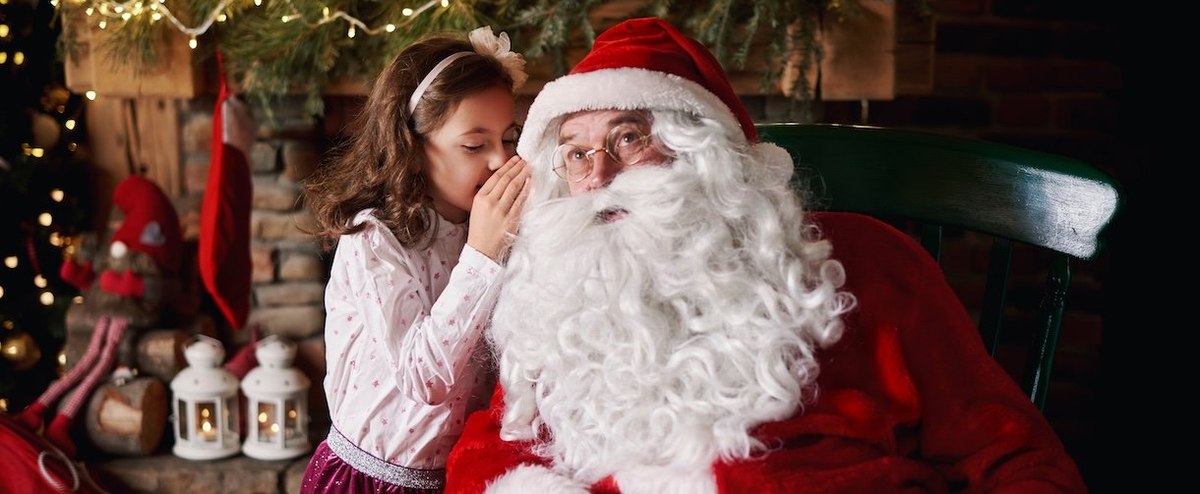
Most Americans (80%) say they believed in Santa as children. Today, 16% of Americans say Santa Claus plays a very important role in their holiday celebration and 24% say he plays a somewhat important role. Americans who have children under 18 are twice as likely as those who don’t to say Santa Claus is a very important part of their holiday celebrations (27% vs. 13%).
A majority (56%) of Americans who are parents of children 18 or younger say their children believe in Santa Claus. Most parents of children under 18 (62%) also plan to pretend that Santa visited their home this year.
Majorities of parents with children under 18 say their children will hang up a stocking for Santa to fill (56%) and leave out cookies and milk for Santa (55%). Smaller shares say their children will visit Santa in-person (46%), leave out food for Santa’s reindeer (44%), and write a letter to Santa asking for gifts (44%).
Compared to this holiday season, in December 2024, more parents said their children would be hanging up a stocking for Santa to fill (65%) while less (45%) said their children would be leaving out cookies and milk for Santa.
When do Americans think children should stop believing in Santa, if ever?. 28% of Americans think children are never too old to believe in Santa Claus. 5% think the maximum acceptable age to believe in Santa is six years old or younger. 3% say it’s seven years old, 4% say it’s eight years old, and 4% say it’s nine years old. 14% of Americans think 10 is the maximum acceptable age for a child to believe in Santa. 15% say the maximum acceptable age is between 11 and 13 and 9% say it’s 14 years old or older.
What do Americans think is the average age for a child to stop believing in Santa? 16% say it’s six years old or younger. 12% think it’s seven years old, 16% think it’s eight years old, and 7% think it’s nine years old. 18% think 10 is the average age for a child to stop believing in Santa.
11% of Americans say they personally stopped believing in Santa when they were 10 years old. 29% stopped believing between the ages of six and nine and 6% stopped believing when they were even younger; 25% aren't sure how old they were.
How did Americans find out Santa wasn’t real? Among people who ever believed in Santa, 41% say they figured it out for themselves, 15% found out from a friend or classmate, 11% found out from a parent, and 11% found out from a sibling.
16% of Americans say that when they were a child, they told someone who believed in Santa Claus that Santa does not exist. 10% say they did this as an adult. These percentages include 4% who say they did this both as a child and as an adult.
Americans are much more likely to say Santa Claus is more a cultural symbol than to say he’s more a religious symbol (76% vs. 12%). Americans who say Santa Claus is a very important or somewhat important part of their holiday celebrations are more likely than those who say he’s not too important or not at all important to say Santa is more of a religious symbol (20% vs. 7%); both groups nonetheless are much more likely to say he's more of a cultural symbol.
Which political party would Santa belong to?
If Santa Claus were a registered voter, 28% of Americans think he would be an Independent. 21% of Americans think he’d be registered with the Democratic Party and just as many (20%) say he’d be associated with the Republican Party.
52% of Democrats think Santa would support the Democratic Party, down from 62% who said this in December 2024. About the same share of Republicans (50%) think he would support the Republican Party, down slightly from 55% who said this in 2024. Among Independents, 44% think he would support the Independents; 50% of Independents held this view last year.
About one-quarter (26%) of Americans agree that there is a war on Christmas in the U.S. today and about twice as many (47%) disagree with this. 41% of Republicans say there is a war on Christmas in the U.S. today, up slightly from the 36% who said this in 2024 (and much lower than the 59% who said this in 2022).
The vast majority (83%) of Americans say that as a child, they imagined Santa Claus as a white person. Majorities of white Americans (85%), Hispanic Americans (86%), and Black Americans (74%) imagined him as white when they were kids.
Today, 73% of Americans imagine him as a white person. Hispanic Americans (81%) and white Americans (76%) are far more likely than Black Americans (46%) to say they imagine Santa as white.
O Christmas Tree: What Americans think of the leading options
71% of Americans plan to have a Christmas tree in their home this year. Among Americans who will have one, the vast majority (81%) plan to have an artificial Christmas tree and 20% will have a real one. (3% will have both and 2% aren't sure.)
Majorities of Americans believe that an artificial Christmas tree is more affordable (62%), easier to set up (59%), and safer (57%) than a real one. Women are more likely than men to say an artificial Christmas tree is more affordable (65% vs. 58%) and safer (61% vs. 52%).
The vast majority (79%) of Americans say a real Christmas tree smells better than an artificial one. 42% think a real Christmas tree looks better than an artificial one, 19% think an artificial one looks better, and 34% think they’re equal.
When do Americans put their trees up? Among those who plan to have one this year, 18% put it up before Thanksgiving. 28% put their tree up between Thanksgiving and December 1, and 30% put it up during the first week of December. 19% plan to put their tree up between the second week of December and Christmas Eve, and only 1% plan to put it up on Christmas Eve or Christmas Day.
Among Americans who plan to have a tree, 47% will top it with a star. Smaller shares will opt for an angel (18%), something else (16%), or nothing at all (9%). Most (57%) people who plan to have a Christmas tree say they will put colored lights on it; 36% will put white lights on it.
As for the size, 40% of Americans say they plan to have a tree that’s between six and eight feet tall. Just as many (39%) plan to have a tree that’s four to six feet tall; 13% will have one that’s under four feet.
Real or artificial, the tree comes down at some point for all but the 1% who never take it down. Hardly anyone (1%) plans to take down the tree on Christmas Day, but many (20%) will take it down between Christmas Day and January 1. Nearly half (47%) of Americans who have a Christmas tree plan to take it down during the first week of January, and 24% plan to take it down later in the month of January.
Related:
- The share of Americans who think there is a war on Christmas has fallen sharply since 2022
- Many Americans think holiday celebrations start too early and that expectations are too high
- Holiday etiquette: How Americans handle gifts, gatherings, and greetings
- Do you think Die Hard is a Christmas movie? That might depend on how old you are
See the results for the December 1 - 3, 2025 and December 3 - 5, 2025 YouGov surveys.
— Carl Bialik and Taylor Orth contributed to this article
Methodology: This article includes results from two online surveys conducted on December 1 - 3, 2025 and December 3 - 5, 2025 among 1,114 U.S. adult citizens and 1,122 U.S. adult citizens. Respondents were selected from YouGov’s opt-in panel to be representative of adult U.S. citizens. The samples were weighted according to gender, age, race, education, 2024 presidential vote, 2020 election turnout and presidential vote, baseline party identification, and current voter registration status. 2024 presidential vote, at time of weighting, was estimated to be 48% Harris and 50% Trump. Demographic weighting targets come from the 2019 American Community Survey. Baseline party identification is the respondent’s most recent answer given around November 8, 2024, and is weighted to the estimated distribution at that time (31% Democratic, 32% Republican). The margin of error for each sample is approximately 4 percentage points.
Image: Getty
What do you really think about President Trump, American politics in general, and everything else? Share your reality, join the YouGov panel, and get paid to share your thoughts. Sign up here.